Order Hope's book: https://a.co/d/0fUqMrq8
Hope's Link Tree: https://l.instagram.com/?u=https%3A%2F%2Flinktr.ee%2Fhopeinthepain%3Futm_source%3Dlinktree_profile_share%26ltsid%3D43761fc5-2216-4d8c-bb5f-0b03dc880141%26utm_medium%3Dsocial%26utm_content%3Dlink_in_bio%26fbclid%3DPAZnRzaAQoDiRleHRuA2FlbQIxMQBzcnRjBmFwcF9pZA8xMjQwMjQ1NzQyODc0MTQAAae4HA0SV6qIAn7WLszJ5xTpHSDSDJH1Z1LouGLsH9JL3PlhPFJJvZ1NtspW0Q_aem_b-H36pqNzzB7TSti365Yvg&e=AT6xtxHCrA9g1WmwFUVdsfCq970OvSUuBnHJAq0v9qt9w3r9sBNGJqZFvuchKgXwZBw8XMp2WhAULyURnPb42ofH2FMAZv2eC2dYPFtXZQbce2vUrnCjrt-IDQ&utm_source=linktree_profile_share&utm_medium=social&utm_content=link_in_bio&fbclid=PAZXh0bgNhZW0CMTEAc3J0YwZhcHBfaWQPMTI0MDI0NTc0Mjg3NDE0AAGnuBwNEleqiAJ-1i7MyecU6R0g0gyR9WdS6Lhi7B_SS9z5YTxSSb2dTbbKVtE_aem_b-H36pqNzzB7TSti365Yvg
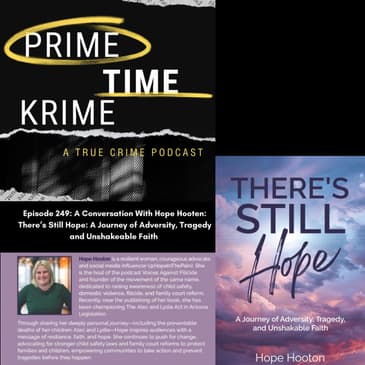
Today's episode, we'll be discussing fill acide, domestic violence, and suicide. Please listen with care. Welcome to Primetime Crime. I'm your host, Kylie. Let's talk right now in true crime, and then together we're going to work on warming up some cold cases. Let's go. Hey, guys, welcome to this week's episode of Primetime Crime. We are not going to do a right now in true crime this week because I really want this week to be all about the guests that I am having on. I recently sat down with new author Hope Houtin so she could discuss her book, a little bit about her journey, how she got to where she's at now, and all of the amazing work that she's doing in legislation to try to change laws to keep kids safe. And protect them. So we are going to get into that interview now and I will see you guys next week for a brand new episode. Today, I am honored to welcome Hope Houtin to the podcast. Hope has devoted her life to honoring the legacy of her children, Alec and Lydia. After their lives were taken as an act to philicide by their father. Hope has turned her focus to advocating for legislative changes to protect children so what happened to her children doesn't happen again. She's the host of the podcast Voices Against Philicide, and on. March ninth, she officially launched her. Book, There's Still Hope, A Journey of Adversity, tragedy. And Unshakeable Faith. Here to talk more about her book and to share with us about her journey and how we can help support her in her efforts is Hope Houton Hope. I'm so glad to have you. Welcome. Thank you so much for having me. So we're going to get into all things about the book because that is the reason we're here and it was so well done. Well, let's start off by having you introduce yourself to my listeners. Tell us a little about yourself and what brought you on this journey to advocacy, podcasting and now becoming an author. Yeah. So my name is Hope. I'm just an average person before my journey started with this. I'm a teacher by trade, So I taught in the classroom for over ten years and I had a you know, family and everything, and we'll get into it. But a tragedy occurred where my estranged husband shot and killed my two children, Alec was seven and Lydia was six, and then he took shot himself as well. So that's where it all started. In the blink of an eye. One minute, my. Life was normal, and the next minute I had to figure out if I was going to either bury or cremate my young children. And I cannot even imagine when I first heard your story. I met you through Rachel and Heather from Like Mother, Like Murder, and when I first heard your story, I was just utterly devastated for you. And the one thing I said in the back of my mind is this woman is strong, She's fierce, and if there's anyone that's. Made to be on this journey, it's her. Because your name, Hope is just so fitting. And that was one thing that I think just really stuck out to me. It's like, from the very beginning of time, your parents knew that Hope was the appropriate and perfect. Name for you. So I remember hearing about you writing your book, and just a few short. Months later, here we are. I know it wasn't a short few short months for you, but it seems like you did it so quickly. So what led you to. Writing the book, and how did you decide to take that leap from going from the advocacy work that you do, which we'll talk about, to writing this book. Yeah, I mean, I really wanted to write the book as a healing journey for myself, and then it kind of turned into, well, I already have the social media platform online, and there are certain things on the platforms that I can't say because I'd be flagged. So I wanted to write a book so that I could be perfectly honest and real and raw and not have anybody like you know, take down my content because it's in a written form. So yes, that's a really really good point. And I am going to be linking the book down below in the show notes. It's available on Amazon paperback and ebook, and I do have to brag on you, hope, because as of this morning. When I looked, and your book hasn't even been out a week. The paperback ranks number thirty five in survival biographies, number forty four Christian Death and Grief, number three, forty nine in Christian self help, and then the ebook number ten, top ten in Grief and Loss, number fourteen in Personal Transformation and spirituality and number seventeen in spiritual healing. That is amazing in less than a week. I am so proud of you and I thank you Lydia are just smiling down so proud of you as well. So congratulations on an amazing what six days since they're release, Yes, that's so amazing. So we are going to get into more in depth in the book, but I did want to start off by having you explain what philicide is to my listeners if they aren't familiar with what it is. Yeah, philiside is the intentional act of a parent or caregiver taking their own child or children's lives. Philiside occurs more than five hundred times a year in our country, and that averages out to about one to two children a day in our country seeing their lives at the hands of a parent or caregiver. So this is a silent epidemic that is continuing to occur, and so that's why I'm bringing awareness to it and also changing legislation in the state that the tragedy happened for my children, so that it can be prevented and not occur anymore. That statistic is astounding to me, that five hundred it it just completely blows my mind. But that is the rate at which this is happening. It's terrible. Yeah, it really is. So. Like I said, your book, it is a very easy read. I think I read it all in like a day and a half, and I. Probably could have read it a lot quicker. But I can't sit in focus for more than five minutes. But I loved your book. It is so great, Soky. So we're going to start at the beginning. One thing that really struck me is that from the very beginning of. Your life you were born almost four months early. Is that correct? That's correct, and you had a. Lot of challenges and adversities that you had to face as a child. Can you share a little bit of about that and your childhood and your upbringing. Yeah. So, because I was born so prematurely, I have a visual impairment called retinopathy of prematurity ROP. For sure. I actually had the same visual impairment that Stevie Wonder has. But I can see. I can see enough to function in the world, and a lot of it has to do with because I didn't have full vision, I've learned to adapt. So probably compared to if you put somebody else in my body, they wouldn't be able to function. But because I've learned. To deal with life the way I have to, I can function very well. My friends and family. Often, especially my friends, forget that I can't see, which is hilarious because sometimes if we go out at night, especially at night, I can't see. I'm completely night blind, and so I have to just sometimes stand there until they notice that I'm not walking anymore and they turn around and they're like, oh, why aren't you moving? I'm like, because I can't see where I'm going. Oh, I'm sorry, I forgot. How's you forget? Like? What do you mean? Yeah? And just the adversity and the different challenges I've had to face, you know, because of my visual impairment, I had to have a lot of accommodations in school and learn how to basically learn in a different way than everybody else. And then because of that, I also was bullied a lot. And I don't use that term lightly. It was extreme bullying, you know, for back in the day especially. Yeah, and so oh yeah, that was a big, a big hurdle that I had to overcome. So yeah, yeah, kids are just so mean. I can't even imagine what you went through, but I'm sure that that helped shape you and build you into the amazing woman you are today. Yeah, and that's really why. Another reason I wrote the book and I wrote it the way that I did is, you know, you read it, but every portion of the book is a is a way that my life has shaped me right to make me the person I am today. Yeah, for sure. So another thing that struck me in the book was your parents and their adversities and issues that they faced as well, and you grew up seeing that. Can you talk a little bit. About your mom who had a stroke when she was only forty, and then your dad and his Type one diabetes and kind of growing up around that. Yeah, So, I mean those things were very difficult for me. Looking back, it was a lot of you know, my life was a lot different than everybody else's because, yeah, my mom had a stroke at forty and had to learn how to talk all over again, and you know, during that time, you know, my household was kind of in upheaval because my mom was the primary caregiver of me, and then when she had the stroke, you know, yeah, she could care for she could care for me, but she really couldn't care for me in. The ways that she used to. I remember one specific thing is when she had her stroke and she was learning how to talk all over again. The first word, like when I say talk all over again, Like she had zero speech when she had her stroke, so she had like literally learned from square one, like a like a baby. And so her first word was no, And literally she would say no for everything. So I'd be like, Mom, can I go to my friend's house? And she'd be. She'd say no, but then she'd shake her head yes because she really met yes, but she she only could say no. So that and then my dad's Type one diabetes. Yeah, it was a part of our lives, our whole life, and you know, that was a lot to take care of, it to handle as a small child. So I don't want to give a lot away, but there's a lot more details in the book. Yes, yeah, it was a very insightful story. I work with stroke patients, so. Reading that and knowing that that's what you had to face as a young child, it just broke my heart. But again shaped to you have become today and the reason that we're here. So it's just another little notch in your journey. Yep. So let's talk a little bit about you know, that time in your life, you're growing up, you're in school, you had the visual impairment, I know you had some issues with bullying in school. So can you talk a little bit about what got you interested in wanting. To go into teaching and kind of how all of that came to be. Yeah, So I really felt called to be a teacher, and because of the teachers that helped me succeed. So much in my education. Right, if it wasn't for you know, these teachers who stepped up and really cared for their students, I wouldn't have been as successful as I was. And there's a lot more detail in the book with that. Now, all of my teachers were helpful and that there were some setbacks, But yeah, I wanted to be a special education teacher specifically because of the way that my teachers took such great care of me. I wanted to be that teacher for somebody else, some other child, some other children. So and I was, you know, I was a special education teacher. I got my teaching license, and I taught in special education and general education for over ten years, and. That's amazing it takes such a special person to go into special education. I feel like we have so many parallels. I have a brother with autism, so he grew up in special education classes and I can still name all of the teachers that had such a profound impact on him and on us as a family, because it's challenging to have a child with special needs. In the family. So yeah, and I still have their support, you know, I have some of my parents that I had their children, you know, way back when. They're still my friends on Facebook, and you know, when the book came out, they bought it, you know. Yeah, step every step through my journey, they've you know, supported me, which is amazing because now their children are in college, so you know, they're not third graders anywhere like they were when I taught them. They're a college student. So it's crazy how time flies. You know, years passed by and before you know what they are, they're in college. It's just crazy. So, if you feel comfortable, do you mind talking a little bit about how you met Brock, the man that you would marry, the father of Alec and Lydia. Yeah, so we met at university at a Christian organization called Inner varsity. It's on college campuses around the country and they basically on Thursday nights our campus would come together and have like a church service with worship and a message, and we would do different retreats around the state. And so I remember meeting him specifically at like a lock in. I don't know back in the day if you read that churches would do. So I met him at a locke in and yeah, and then we just we were friends for a long time and I stepped out in faith and just decided to ask him out. And you know, there were steps along the way in my book that I will go into more detail, but obviously we ended up getting married, and we moved to Arizona because I was applying for teaching jobs and I got hired at a teaching job in Arizona. So we moved from Michigan to Arizona and we started our lives there, and you know, had Alec and then you know, twenty two months later, we had Lydia. So can you talk a little bit about Alec and Lydia? Maybe a favorite memory or something that just brings a smile to your face when you remember them. Yeah, So Alec was so inquisitive and like happy. He loved to sing and dance. He loved to play his music on his tablet super loud, so I would always have to go in his bedroom and tell him to turn it down, because literally he would have it on the highest volume and I could hear the music, like. What is that song by? Like like the Trolls theme song, yeah, and like and like the. I don't know. There's so many songs that he would like play at the top of the volume of the tablet, and I'd be like, like, you have to turn it down, Like I can't, like I'm weigh in the kitchen, Like I literally can hear your tablet from the kitchen. And he loved to play soccer in basketball. He was an active member of Trail Life, which is like boy Scouts, but it's more Christian based. He was in that for two years. He loved that Lydia was very creative and she loved to spend time with her big brother. I remember there were many times that she wouldn't play in her own room. She would play in Alex's room, so like, I would find them both in his room playing with magnet tiles or making forts, and like she had her own room right next door with all of her toys, but she would always play with Alec. But yeah, she she loved. They were like they were inseparable. I mean, they were siblings and they you know, bickered back and forth, but they Honestly, I've never seen such a stronger bond between two siblings at such a young age. And they you know, they were young. They were only you know, five and seven because I say that because Lydia just turned six before she five days before she passed, so really, you know, five and seven years old, and you know, they were so close. So they truly sound like such amazing kids. I feel like I know them just through everything I've learned about you and them, and I wish I would have had the chance to meet them. But you sharing about them, I think it's just such an important thing. Yeah, so they sorry. It keeps It's okay, it keeps their memory alive, right. I think that in my journey of sharing their story and sharing what happened, a lot of people fixate on how they died, right, And I want to really fixate now on Yes, we want to talk about how they died, and we want to prevent that. But I also want to I want to talk about how they lived, and I think this book shares a lot of good memories about how they actually lived as children, and. You know, in their short lives they made such an impact. I mean and still to this day they're making it impact. So there is a lot of good memories and stuff of Aleg and Lydia in the book. So you guys will have to check it out so you can learn all the things about them. But they sound like they were truly amazing kids. Thank you they were. So can you talk a little bit about, if you're okay with it going into the next chapters of your life with Brock and Alec and Lydia and how things kind of evolved from where it was to where we're at now. Yeah, so you know, there was always manipulation and little things of coersive control. Of course, back then, I didn't realize those things. I didn't really know what manipulation could look like on a daily basis. I didn't know really the ins and outs of coercive control. And for your audience, if they don't know what coursive control is, it's a form of abuse, but it's a form of abuse that you can't see, so it's when the abuser or the person in power has power over the other person. And so coersive control happens now just in relationships and marriages, but coercive control also happens in like businesses and and legislation. And it's a big it's a thing that is a part of our society. And so when it's not used, if it's used every day and and taken advantage of, you know, it becomes this big thing that you know, the the power and balance is off right. And so I had no autonomy in our relationship, and so I didn't have the choice, you know, what I could wear or a lot of times he would pick out clothes for me, and it came from the point of I want to make this clear. He wasn't picking out clothes for me and saying like you have to wear this all the time. He would often say it as like I'm gonna wear it blue, so you should wear it blue. Like he he made it so that like, oh, we're gonna do this together. But now looking back, it was like I couldn't I I couldn't wear what I wanted to wear. I would have to go find something blue. Right, So and you know, that came down to like what we ate, and that would change from month to month. So like one month we would eat something or go out to eat at this restaurant, but the next month I would suggest the same thing and he'd be like, oh, no, we're not going to do that anymore. We're going to eat at home and we're not going out to eat anymore. So it was really it was like a roller coaster. I couldn't keep up with you know, what he was going to say next, Right, It was like walking on eggshells because I didn't know what I was going to encounter from. Day to day. And some at the very very end, it was, you know, hour to hour, I could I could go wake up and say hi, and he'd be perfectly fine, and then I could go take a shower and thirty minutes later I could walk out again and be a completely different person. So it was it was very scary because I didn't know what I was encountering. So yeah, and then it moved forward from there. I separated from him, I asked for a divorce, and then kind of the whole spiral of you know, the rest of our story happened. You know, I wanted it to be you know, two parents co parenting. Well, and that wasn't my story. Uh. He spiraled and had a behavioral health crisis where he took the children out of school without my knowledge and took them to a hotel. He then was having uh, paranoid thoughts and illusions of demons and cults, and he thought that me and my church were the Church of Satan and that people were after him, and so he called nine one one on himself and nine to one one, Uh, the police came and they actually took him to a hospital facility for treatment. And I actually had to come to the hotel and pick the kids up, and then from there I had to call my attorney and get emergency tempary orders because I was scared for their safety. We went to a emergency temporary orders hearing after that a few weeks later, and you basically and the hearing have to state like if you believe that the emergency temporary orders should stay in place or if they should change and watch you know what they should change to or stay the same because of why. And so I was like, I want supervised visits and this is why, because I don't feel like he's stable enough yet he hasn't been on his medication long enough. He was, you know, in a behavior, real health crisis and you know, put the kids in danger. And then he was asking for unsupervised fifty to fifty custody right out of the gate, and unfortunately, our judge gave him unsupervised fifty to fifty custody and that was just about two to three weeks after after he was hospitalized. So that was very scary. And in the court systems, I want people to understand that you have to co parent well with your abuser, otherwise you are looked down on in the court system. You are considered the protective parent, you are considered the mother who is causing the issue. And so I had to co parent with this person that I knew might not necessarily be the safest around, like in lydia, especially on supervised, but I had to do it because that's what was granted. And you can't go against orders from a judge otherwise you will be put in contempt of court and you will be taken to jail. And yes, that does happen all the time. So I want to make sure that your listeners understand that because that was one of the things. When this tragedy first happened, I got a lot of comments online saying, well, I would have just taken my kids and taken them out of the state. No, you wouldn't have, because I mean you might have, but then the police would have found you, brought you back to the state that you came from, and then put. You in jail. So you have to follow the orders that the judges put in place. It's a law, and so I did that. We co parented, you know, as best as we could, and the kids got into a normal routine. He did get a court ordered psychologically evaluation done and so that evaluation have red flags in the evaluation. Unfortunately, the judge did not see those red flags or take those red flags into consideration, and so he kept the orders in place for the whole time. So fifty to fifty n supervised was what stayed in place until they were found deceased. So the weekend that they were found deceased, I sent them to school like normal, he picked them up like normal, and then on that Sunday Sunday, they went to church, and then that Sunday night they were found deceased. I didn't know anything happened until the next morning until I got a phone call from the school stating that there was an unexcused absence. I called and left voicemails and text messages, no answer. I went over there and knocked on the door. There was no answer, and I could hear their phone from me calling it. I could hear it ringing from inside, and I saw his vehicle in the parking lot, so I also know that something was wrong. So I called the police and they came. They did their due diligence and you know, knocked down all the doors and windows and asked me all the questions, and they finally got permission from their sergeant to go inside, and they found all three deceased from gun chat wounds to the head, Alec and Lydia where gunshot wounds to the head, and then Brack was a self inflicted gun chat wound. I just cannot even imagine that the whole thing from start to now, the cycle of abuse, and how everything just seemingly progressed. And again you talking about the court system. That's what so many people, I think don't understand because it's really easy to from the outside looking in just that type of situation and say, oh, yeah, I would have just taken my kids away anything to protect my kids. But it's the court system. You have to abide by it. And you know, unfortunately, there are judges out there that, for one reason or another, they want to make both parties happy, and they don't see the writing on the wall. They don't see the red flags. So you have to do what they say. You can't go against that. And we saw that in the Josh Powell case. I mean, that is a prime. Example of a semi similar situation where the red flags were there, and unfortunately it ended up in the loss of you know, his children. And that was during this supervised visit, what was supposed to be a supervised visit. So it's really just sad and unfortunate that that happens. And I know, in all the work that you're doing, you talk about it some in the book, but can you talk about some of the legislative stuff that you're doing, the Alec and Lydia Act. Can you go into detail a little bit about what you're doing with that so that this doesn't happen again. Yeah, So the alec and Lydia Act came from a bill that was an extensive child safety bill, and it was probably about thirty pages long, and we met several times over before the legislative session started in Arizona, so this would have been last year, twenty twenty five, and so we wrote that thirty page bill. Legislators looked at it. They said, these are some really great concepts and really great legislation that we want to put into place, but we can't take this full thirty page bill because the bigger the bill is, the more issues somebody's going to have with it and pull it apart, and it's not going to make it through the through the process, right. So we took that page. We took that thirty page bill, and we broke it down to several other smaller bills and so, uh the Alec and Lydia Act as it is now is the Coercive Control and Domestic Violence Bill, and so that bill specifically deals with domestic violence. And coercive control, which is huge. Arizona, if this passes, will be one of the first states in the United States that includes coersive control in legislation. We see that coercive control has already been put in legislation within the UK and also Australia, so the United States is. Coming slowly up behind them. So this is huge for Arizona if they pass this because, like I stated earlier, you know, costive control is something that you know can't really be seen, and so you know, judges have to be aware of these things. They have to have training on domestic violence and coersive control and what those things might look like in the court system and how they might play out within family court and so. And also the Domestic Violence Bill takes away what significant domestic violence means because in the previous statute in Arizona it stated significant domestic violence. Well that term is really ambiguous because like, well, what's significant one black eye or two black eyes? You know, Like so they took significant out and they just put domestic violence because they need to look at the whole picture. Right, it doesn't matter if somebody has a black eye or a broken rib or you know, a stab wound, it doesn't matter. It's all domestic violence. If you put if you put your hands on someone, it's all domestic violence. And within that, they also talk in the bill about, you know, like I said, that coercive control peace because that's more of the emotional and psychological abuse, and that's really really important. That coercive control is why survivors don't leave right away or they go back to their abusive partner. Statistically, it takes seven times for a victim to leave a domestic violent situation. Seven and so. That's very scary. And so we have to make sure that these judges in this full court system understand this. And that includes attorneys, that includes people within the courts, you know, like friend of the Court and DCS has to be aware of this as well, or you know, Department of Child Services. So it's it's. Really important and so that's why I want to make these changes, and this will protect children moving forward as well. And then we also have another bill that we're going to continue need to work on. It's a Behavioral Health Crisis Bill, and that specifically focuses on people who have a history of domestic violence coupled with a mental illness and if those two aren't checked with, you know, medication or therapy, they result in philicide. We know that with a history of domestic violence is coupled with mental illness, it causes philicide to occur. So we really want to educate with that and that's been something that I've learned. You know, at the very beginning, I was like, well, he had mental illness and this is what caused it. No, no, no, no, I take that back as well. Mental illness does not cause somebody to be violent towards another person. It's when domestic violence and mental illness are left unchecked is when the you know, violence towards anyone can occur, not just children. Yeah, and that I mean, when you put it like that, it just it makes so much. Sense, right, It should. It should make sense to people too, because you know, I see comments a lot, well why didn't you just leave? Why didn't they leave? But it's just not that simple. And I think a big part of what you're doing is just going to be to educate the masses as far as like how this starts like, it didn't start off horrible for you. It's it was a slow kind of a slow burn, right, and then you know, before you know it, you're in this horrific situation that you could have never thought that that would be how things would turn out. So I think it's so important to do what you're doing. Educate, bring awareness, and not just for the common folks, but for the judges and people that work in the court system and the people that are in charge of, you know, giving these arrangements to parents and stuff. Everybody needs to be on the same page. And when you said that that mental illness and the abuse kind of can go hand in hand to turn into fill aside, it completely makes sense, because you're right, just because you're mentally ill doesn't mean that you're going to commit these, you know, horrific acts against a person. But when they go hand in hand and there's. Evidence of that, it makes complete and total sense. So I think what you're doing is so important, and I know there's going to be so many lives saved because of it. So yeah, I'm really excited, and I know, you know, I wish I wasn't in this position. I wish, I say excited. I'm excited to save children and families so that they don't have to endure the pain that I have. Right I wish that I could bring alec India back and I'd still be a teacher in the classroom. I wish that this wasn't where I am right now, but it is. It's my path, and so I have to just you know, move forward. For Alec and Lydia's legacy, and I wanted to share with your audience. The Alec and Lydia Act, the Domestic Violence and Coercive Control Bill, has passed through the House Committee and through the House floor. It passed fifty two yeses to zero NAIs, and now it is on the way to the Senate Committee and then hopefully the Senate floor and then it will be then if it passes those two, then it will go to the Governor's desk and they will have to sign it. And that I get chills hearing about that, because I mean, it has to pass, it has to go all the way to the governor's desk. It just has to be and not just in one state, but you know, across. The country because oh yeah, it's unfortunately, you know, five hundred a year in the United States. That is such an alarming statistic that has it has to be zero. It just has to be yeah, think yeah. And so we're starting with Arizona. Obviously, you start with where it happened because you have the most you have the most like uh support there, and then you know, I live in Michigan now, so we already are starting to work on it. Here in Michigan, and as soon as it passes in Arizona, I'll take that bill and move it to Michigan and hopefully pass it here and then you know, I've gotten people, you know, from Georgia and from Illinois saying that they want it there. So yeah, we're gonna take it slowly, state by state and then hopefully, you know, maybe to the federal level so that I won't have to individually go state by state to everything. Yeah. Yeah, that would be amazing, and I know you'll get there. So one thing that I was a constant in your book, and I want you to talk a little bit about it is your fate that really has guided you through everything from childhood to where you're at now. Can you talk a little bit about your faith and some challenges maybe you faced along this journey and how you've really leaned into your belief in God and his path for you. Yeah, so my faith is huge. I I wouldn't be here without it. There are two things that you can do when you are faced with a tragedy like this. You know, losing a child or children is a devastation that is the most egregious. In this world. And so you know, either I could have ran away from God and from my faith, or you can come closer to it. And you know, the Bible states that, you know, we learn the most about the path that Jesus has for us, God has for us by suffering. We don't learn the things on this earth by sunshine and rainbows, right by everything going well. And so I remember state, you know, sitting in silence every day after this happened, with a journal with a pen in my hand, and just in complete silence, no phone, no music, just nothing, and I would journal, and I remember thinking and saying out loud why more times than not. So it's not like I didn't question God and why did this occur? And I never for one instance said why did you do this? God? Because I know as a believer and as a faithful Christian that you know in the Bible it states that we have free will here on this earth. So I believe that Brock. Had the free will to do what he did, and that God let Alec and into Heaven when they entered Heaven's gates, and so he didn't as in, God didn't let this happen. So I don't believe that. I believe that it was Brox free will that this happened, and so I just you know, keep moving forward. I've come to the realization that I'm supposed to be here to not only share legislation and change laws, but also educate people about the family course system and domestic violence and philicide, but also within those things, I talk about my faith all the time because they all intersect. So in every podcast I do, in every interview, in every presentation I give, I always talk about my faith because it's something that is interwoven into my daily life. And I believe that the reason I'm here on this podcast today is because he opened the door for me to be here. He opened the door for me to go to Crime Con last year in Denver, he opened the door for me to be on several other podcasts, and so it's my job, once he opens that door, to walk through it. Yeah, I a million percent agree with that. I think, you know, life is full of lessons and things that set you up to become your future self, who you're supposed to be, and I to find myself just leaning on this. You know, this is the journey that I'm on. These are the lessons I'm going to learn, and as much as I hate that we have to have this conversation today, it's a blessing because we're going to reach so many more people. And the fact that you've been thrust into this awful journey, you're making something really good of it, and I think that that's really amazing. That's what God is using me for. I think that's great. Yeah, I mean, he'd you know, in Genesis it says that you know, he will, you know, what was meant for evil will be turned to good. And so I believe that, you know, I believe that this evil thing is now being turned to good, not to just help me, you know, heal, but to help families and women around this country and children. And I'm doing that by not staying silent. I'm doing that by speaking up and raising my voice to to do this. Yeah, for sure. So I did want to kind of circle back to the book writing process. What did that look like for you? Were there any major challenges you faced? How long did it take you? I have just so many questions about that whole process. It was a long process. I started writing the book probably like in September or October of twenty twenty four, and I just sat down where I'm sitting right now, opened up a Google document and just started writing. And a lot of authors start all over the map, right, they don't necessarily write in chronological order. But because mine was a short memoir and because of the way that my brain works, I had to. So I had to start all the way back at the beginning and move all the way forward, and it took a long time to type it out. I can tell you that my first couple drafts were not what you. See right now. In the book, you know. I, then, you know, had to really struggle with what do I put in the book? What do I keep out of the book, because there are things that have happened to me that I didn't include in the book because it's too much, right, I had to be I had to be tactful, right, especially when it came to the abuse. I didn't want to just word. Vomit all over everybody, because I know what would be impactful and what would be too much and make you like turn away and not want to read anymore. So that was a delicate balance to find that. Then, I think my hardest part was also finding because I have a co hybrid publisher. Because I didn't know how to publish. I didn't know how to edit, you know, professionally, especially the cover design. I had no idea how to do that. So they really helped me with the cover design and editing, and then they walked me through the steps of how to publish my book. And so I did that, and yeah, it was just a big team effort. So once I had them in my corner, they kind of took the book and and started editing it and we made the cover design. Honestly, I was the one that made the cover design. I had the idea with the clouds and the purple and the pinks, and. I did that. The title of the book actually came from my brother in law, There's Still Hope. It came from him when I was living with them. This would have been August May twenty twenty four through July of twenty twenty four. I remember we. Were in the kitchen one time and he was like, yeah, you should write a book and it should be called There's Still Hope. And I was like what. He's like, I'm like, say that again. He's like, yeah, it should be called There's Still Hope, because like your hope and then you have hope in Jesus, and I was like, oh, yeah, so I wrote it down in my notes and then like yeah, like now it's twenty twenty six and in March, this was just released, and that's the title, There's Still Hope and so, and obviously we had to do a subtitle, so a journey of you know, adversity, tragedy and unshakeable faith. But the title There's Still Hope came from my brother in law. I love that that. Like I said, your name Hope is just so appropriate. It's it's perfect. It's literally set you up for this life of just being an advocate. And an amazing human who I'm so glad to know. Thank you. I'm so happy to know you. Now. One thing one of the things at the very end of the book that really stuck out to me, and I hope you're good with me sharing this, is that you talked about your forgiveness of Brock and I think for those that are also on this same type of journey, I feel like that is just such an important piece. And I'm sure there's you know, mothers. Out there who have lost their children due to phill aside who are struggling with that. So I think you putting it there in life and white is so important. Can you speak on that a little bit? Yeah, I really believe that, you know, forgiveness was my own, my own journey, and I believe that I needed to forgive him and give that over to God and move forward because I didn't want to live here on this earth with unforgiveness and a heartened heart, because I knew that if I had those two things, I couldn't do what I'm doing now, right, I couldn't have unforgiveness and a hardened heart and still move forward and advocate and change legislation and talk to people. In the demeanor that I normally talk to. People in if I didn't forgive. And so I wanted to do those things because I couldn't move forward in my grief journey and my healing journey without forgiving him. And it circles back to my faith, right. You know, I believe that, you know, the darkness of this world caused in the sin of this world, caused Brock to go down that spiral of darkness, starting with the domestic violence and then entering into you know, taking Alegan Lydia's life and then his own life. You know, that's in my understanding, in my opinion and belief is that's Satan, that's darkness. And so I believe that. You know, I didn't want to stay in that darkness, and I wanted to move. And because I know that he's no longer here in that darkness, he I believe and I know that you read this and you understand. I believe that he's in heaven with Alegan Lydia, and I state that in the book. And I believe that because he was a follower of Jesus, he brought people to know Jesus. And if you really get into the scripture and know the Bible and what it really states, it states that you can't sorry, you can only not get into heaven once you declare Jesus as your Lord and savior. The only way that you cannot get in is if you denounce Jesus as your Lord and savior. And Broc never did that. Brock never denounced that. He didn't believe in Jesus. And so I believe that he is in heaven in his glorified body, and he might not be in the same room as Alec and Lydia because in the Bible it talks about Heaven is in different rooms or however you believe that to be. I don't believe that he is necessarily co mingling with them, but I believe that he is there and that he has his glorified body as well. And I believe that God met him there and he had to see the acts that he did on this earth and sit with that and understand what he did, and then. He went to heaven. I believe that Alec and Lydia obviously are in heaven and with my parents, and that gives me. That gives me peace because they're taking my mom and my dad, their nana and Papa are taking care of them until I get there. Yeah, for sure, agree with everything you just said. So can you tell us a little bit about what events you're going to be at. I know I'm going to see you at Crime con but I know you have a lot of other things on the horizon. Can you talk so much about that so much you're going to be a girl? Yeah, Starting in April, I have April eleventh and twelfth, I will be in Albuquerque, New Mexico at Beyond the Crime Convention, and I will be there speaking alongside Brandy Morey Poles, which is the mother of Rowan Moury who lost his life at the hands of his biological father and an act of philicide. And I have teamed up and we are kind of we are doing this movement together because we've realized that more than one voice makes a bigger impact, so we are speaking together at that event. We will both have tables in the expo hall for that event. I will have the Voices Against Philicide table with my book that you can come and purchase in person. I can sign it for you. And then also Brandy will have the Rowan Project table as well, which is a nonprofit organization that she's developed after losing her son Rowan. And then in let me see in May, I will be coming to Crime Con and I will be having a booth there for Voices against Philiside in the expo hall, selling my book and doing all the things, so come and see me there. And then. In September, I will be at Advocacy Con back in Albuquerque, New Mexico September, I think it's eleventh through the thirteenth, and I will be there speaking as well on legislation, so how I passed the ILEC and Lydia Act. And actually Brandy will also be there speaking on how she passed the Rowan Act. So or is in that we are both in the process of passing, I should say. So yeah. And then here in Michigan in May May eleventh, if you're in Michigan, in Oakland County and Lake Orion, I will be hosting an event with a local church here and it will be all on domestic violence within the church and what our faith and what God says about domestic violence within marriage and talking about those those things. And I'm so blessed to be able to do this because you know, domestic violence is really a taboo topic within the Christian faith, and so to be able to have this door open and to host this event is very powerful. And I'm not only just speaking at this event. I actually created this event with someone else who has gone through domestic violence as well, and I've partnered with her and We've created this event and it's called Hope and the Pain, just like my social media and so yeah, it's it's really cool because I've created my own event. That'mazing. So yeah, you just have so much. You are going to be so busy for the next few months. And I can't wait to see you at crime Con. I got to meet you at crime Con last year and it was great to meet you. I had to spend as much time with you as I wanted, but crime Con is so busy. So it is, it is so busy. I was like, I didn't I mean, it was my first time going and I didn't know what to expect. There were so many people literally had to because of my vision and there's so many people. I had to literally be be tied to either Rachel Heather or my friend Laurie. I was like I literally held onto their arm to make sure that, like I didn't get moto. Yeah, because there are there are so many people. It's crazy how busy it is. It's it's a good thing though, because there's so many advocates there and you know, so many people that you've watched on TV and you've heard from over the years, and you got the opportunity to share Alec and Lydia's story with so many of those people. And I think that that's just so special and that's what crime Con is. Yeah, that's what it's all about. Yeah. I got to meet you know, Nancy Grace, that got to meet Ashley Banfield. I got to meet the people from Dateline, you know, not just meet them and take a picture and say hi, but like, I had conversations with these people. Yeah, so they That was huge for me and I will always remember that and just the kindness that they had. Yeah, because obviously they're at a crime convention and they hear, you know, stories of missing and murdered people all the time. But I feel like because. A lot of missing and murdered people at crime con are adults, they don't necessarily get a lot a lot compared to adults of child missing and murdered. So I think coming up to them and seeing their physical reaction on their face when I'm sharing their story, I think that really hit home with them. Yeah, yeah for sure. So where can people find you? How can they keep up with your journey? Yeah yeah, yeah, yeah yeah. So hope in the pain on all social medias, So hope in the pain. And then I have my website which is Voices against Philicide dot odo dot com. And I will give you the link tree, so if you want to, just go in the show notes and click on the link tree, and it has all of my socials. The website, it has the book, everything that we have for the voices against Philicide, legislation, everything is in there. So amazing. Yes, I will link all of that in the show notes. Now wrapping up, is there anything else that you want to share about your book with my listeners? Is there anything else that you didn't get a chance to talk about that I didn't ask that you would like to share. Yeah, I would really appreciate it if everyone goes out and purchases my book. This is not just ink on a page. This is a real, raw, true story that happened and all of and that is still happening, and legislation is still being changed, and awareness is still being brought to light. So I ask that you purchase the book. All proceeds from the book go right back into the Voices against Philisi admission, It goes right back into the podcast, right back into awareness and going to events. So I really appreciate it, And that's one way that you can support me is by purchasing the. Book as well. Yes, absolutely, I highly recommend the book. I'm going to have it linked below. Get yourself a copy. If you're going to Crime con bring it with you. You can buy copies at Crime con as well. I'm going to have you sign my book. I'm going to bring it with me to have you sign it. Yes, So everybody go get the book. That is the call to action today. Go get Hope's book and leave her a verified review on Amazon. There also the podcast as well. Yees. So we've noticed voices against philiside. We've noticed since the book release in just six days that our numbers have increased, and we believe that's because people are going and purchasing the book and seeing about the podcast and going and looking it up. So please voices against philicide as well. That is free wherever you find your podcast. Yeah, highly highly recommend. Hope does an amazing job. She interviews people and she's just she just is just doing an amazing job with everything, So please check that out. So, Hope, I wanted to thank you so much for coming on today, sharing this journey that you're on, and I'm, like I said, so honored to know you, and I know that my listeners are going to also, you know, enjoy I hate to say enjoy hearing. This, but I know I know you're turning. Your journey into something that is going to help so many people. And I think that. That's really Alec and Lydia's legacy and yours as well, So I need to commend you on that. So thank you so much. Thank you so much for having me on the podcast today. I really appreciate it. You have no idea. Every podcast, every interview that I do brings more and more awareness. And you're just like we say, you're a part of my train. Now you're a part of my group of people that are continuing to push the voices against philicide movement, and now you are a voice against philicide. Yes, and it takes a village, So we are all here for you, Hope. Thank you, thank you.