
Main source: Thou Shalt not kill: Mary S Ryzuk
American Justice - To Save Their Souls (Feb 12, 2003)
https://abcnews.com/amp/2020/story?id=132646&page=1
https://grokipedia.com/page/Helen_List
https://forensicfilesnow.com/index.php/tag/helen-list/
https://murderpedia.org/male.L/l/list-john-emil.htm
https://www.nj.com/news/2008/03/no_one_has_stepped_forward.html
https://www.mycentraljersey.com/picture-gallery/news/history/2023/04/11/list-verdict-and-murders/11636988002/
https://www.newspapers.com/image/1189034631/?match=12&terms=alma%20List%20
https://www.zillow.com/homedetails/1808-S-Wenona-St-1-Bay-City-MI-48706/450860253_zpid/
https://vocal.media/criminal/john-list-the-murderer-ljx0cwq
https://www.nj.com/news/2022/06/father-wants-us-dead-podcast-extras-never-before-seen-list-confession-report-john-walsh-interview.html?outputType=amp
https://www.latimes.com/archives/la-xpm-1989-06-18-mn-3671-story.html
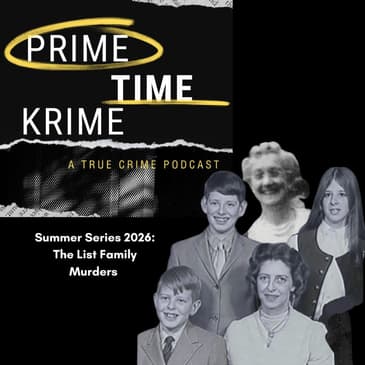
Welcome to Summer Series 2026, The List Family Murders. In this series, we are uncovering the story behind what happened behind the doors of the infamous Westfield, New Jersey mansion. We'll be discussing John List taking the lives of his whole family, his mother Alma, his wife Helen, his 16-year-old daughter Patty, his 15-year-old son John Frederick, and his 13-year-old son Frederick. Let's unpack it all and dive into the inner workings of a man who wanted to erase his whole life and start anew. And for 18 years, he was able to do so. Let's go. All right, guys, we are officially getting into the final episode of Summer Series 2026. In the last episode, John List, aka Bob Clark, was finally apprehended at his work office in Virginia and And with that, news started to spread like wildfire that John List had finally been apprehended after all of this time. Ex-police chief James Moran had been enjoying his retirement. He had been retired for three years exactly to the day and had just sat down to dinner with the, at the time, Westfield police chief when they got the news that John List had been apprehended. Obviously, James Moran was shocked that they actually got him. And when he learned the detail that the FBI in Virginia, in Richmond, had been the ones to capture him, James couldn't believe it. They ended up holding a press conference and obviously it was quite a spectacle. The room was filled with some of the best known reporters from all across the country. This was breaking news. The New York Times itself was even there. This was a huge deal because John had been on the run for almost 18 years. James Moran, of course, was right there watching all of the action go down. At this point in time, he still had that FBI flyer of John List that he had carried in his front pocket from the very beginning. It was old and tattered and frayed. And he said that catching John List is the best thing that has ever happened to him. He said that having somebody that murdered five people to be on the run and walk away from it always really bothered him. So he was really, really excited that he had finally been captured and hopefully would be brought to justice. So upon the arrest of John List, a lot of people were questioning what was actually going to happen to him as far as his sentence. When the murders occurred in 1971, there was no death penalty. So there wasn't a possibility for that to be on the table. The most that he could face would be life in prison. But of course, the state would have to prove their case and bring all the evidence that they had against him and so on and so forth. And John was also able to make a defense for himself as well. He was able to retain a lawyer and fight for his side of things as well. So there was no sure thing. that John was actually going to be held accountable for the murders. So while this press conference was going on at the FBI headquarters in New Jersey, Robert P. Clark was appearing before a judge in Richmond, Virginia. There he was arraigned on Virginia state fugitive charges, and he was charged with five counts of first degree murder. He continued at this point to deny the fact that he was John List. even though it had been proved by the fingerprints. He requested that he did want a court-appointed lawyer during this hearing. They ended up setting a preliminary hearing for June 8th, and that is when they would decide if he would finally be extradited to New Jersey, and they decided that he was going to be held without bail. Now, the corrections officers at the jail where he was housed were instructed that he was not permitted to talk to anybody, except for his attorney. He was given the name of an attorney, Joel G. Clark, who was a local attorney. As the news broke even further, local headlines started to blow up. Westfield, New Jersey was buzzing. It was crazy. There was cameramen everywhere, reporters everywhere. There were people outside of the site of the Hillside Avenue home. People were set up at the triangular corner. in the town of Westfield where John had made the withdrawal from Alma's Bank right before he fled. There was just so much going on in Westfield. And keep in mind that the List family home had burned down by this point in time. It burned down shortly after the murders. So there was a whole new house there, a whole new family living there. And people were so relieved that he had finally been caught. People that lived in the area were having list parties. The people that rebuilt 431 Hillside Avenue even planned to have a party to celebrate John List being captured. So there was a lot of people who rejoiced at him being captured. But while there was a lot of people rejoicing, there were also a lot of people who were mourning. Those that had grown to know and love Bob P. Clark were really struggling. The individuals who lived next door to Dolores and Bob, they had become really close with them. They would often watch America's Most Wanted together. They would hang out with Bob and Dolores. They were actually devastated by the fact that Bob could be involved in something like this. The guy that John List lived with initially when Bob made it to completely shocked and surprised. And he didn't know that version of Bob. He didn't know John. He knew Bob. But everybody was so surprised because Bob did fly under the radar, which is exactly what he intended to do. He went to church. He was the kind that was nice to his neighbors. And it was really, really hard for all of them to imagine that Bob Clark would be capable of something like that. including murdering five people, especially three of which were his children. When he was apprehended, Helen's sister, Jean, got the news very quickly that he had been captured. And I'm sure she was feeling some type of way about it because Helen was her sister and she loved her and her nieces and nephews. But then there's also that really weird way of thinking where John was also her family. And she just sat at her kitchen table, reminiscing, looking at old family photographs. And she found the last family portrait from right before John had killed Helen and the kids. And it was a family portrait. I posted it on social media of John, Helen, and the three children. And Jean thought to herself that maybe he planned this. this photo out as kind of like a last family photo if he had been planning everything all along and this was kind of a last ditch effort to have a family photo of all of them because that picture was taken shortly before their murders she did have a hard time with it the whole thing because she was close with john at one point in time and she thought very fondly of him She did express that she was glad that her mother had passed away so that way her mom didn't have to go through this all over again. Because as joyous as it was for John to be captured, it had been almost 18 years. And I am sure you do never get over it, but I'm sure at that point in time, 18 years down the road, they had gone through the bulk of their horrific grief and they were probably getting to the point where it wasn't every single second of the day, a thought in their mind. And then John gets captured and they're immediately brought back to just being in the pits of everything and having to go through it all over again and relive everything all over again with the trial and everything that comes with it. Interestingly enough, though, there are so many parallels to this case. On June 1st, when John List was apprehended, it happened to be Helen and Jean's mother's birthday. Although she had passed away in 1988, she never got to see the day that her son-in-law was apprehended. It was almost like a little sign maybe from Helen and the kids that It all played out the way it was supposed to play out. So when Brenda, Helen's daughter, found out that John had been arrested, she pretty much had to go into complete seclusion. She had had a really tough life. She struggled a lot financially. She had a broken marriage. And basically, she had just been in a horrible bout of depression since her whole family was taken. And she very much hated seeing all of the news reports and such where Helen was painted in such a terrible light. Because at the end of the day, Helen wasn't perfect, but John is the one who decided that he was going to murder his own family. Helen was sick and she really... did the best she could with the life that she was given. And the last victim in all of this was Dolores Miller Clark. Dolores was obviously very shaken by this whole thing. and everything that had happened, but they were going to let her see John while he was incarcerated. So one of the pastors drove her to the county jail to visit her husband. And this is not something she ever dreamed or imagined would actually become her life. So Bob was able to visit with Dolores, but only through a glass partition. They talked for about 10 to 12 minutes. And although the reverend that was nearby was trying to listen to the conversation a little bit, he couldn't really hear the conversation fully. He did get the vibe that the conversation was basically them talking about things that needed to be done in order to keep up the household, paying the bills, stuff like that. Dolores had such a hard time coming to terms with this person that she had married being a person that was capable of killing their wife, their mother, and their children. It just didn't make any sense to her. And at this point in time when she's visiting him in jail, literally they're separated by a glass partition, she's still denying that there is any way that Bob Clark could be John List. With all the media attention that was surrounding the John List of it all, Dolores basically went into seclusion and very much did her best to pray to escape what was going on in her life. In Richmond, Virginia, Bob Clark waived extradition to New Jersey. There was a bond hearing and he remained in prison, awaiting a hearing basically to establish his true identity. Dolores at this point very much tried to keep to herself, but she also realized that she probably wasn't going to be able to stay in the home that they had purchased in Virginia. But she had to stick by her husband because she had made the vows when they got married that they would stick together. There was another hearing that they had to have to basically try and show probable cause that the suspect, Bob Clark, a.k.a. John Lust, had been in New Jersey at the time of the murders. There was also going to be an official comparison of Bob's fingerprints to those of John, and that was scheduled for Thursday, June 8th. And if the prints matched, then Robert Clark would be transferred to Newark, New Jersey, to officially go on trial. Now, they already had done the fingerprint comparison and there was no question, but they had to present all of the official evidence and do this comparison in front of a judge for it to be official. So therefore, they could proceed with what they needed to proceed with. Suddenly on June 2nd, Bob's lawyer dropped his case without any explanation as to why. So he was assigned another lawyer named David Baugh. Ed Alano, who was the drama teacher at the Westfield Recreation Center, had come forward since John was caught and said there were times that both Patty and John Jr. had both expressed to him the fear that something was going to happen to them. He said Patty once told him a story about how her dad had set them all around the dinner table and told them that he was going to have to kill them because he couldn't afford to support them anymore. And he also said there was an incident just before they left on their vacation, which wasn't really a vacation, where John Jr. had grabbed him by the arm and begged him to stop by the house more often, basically begging for help, trying to say something was wrong without actually saying it. And I think that's really, really wild because I knew Patty knew something was going on and something was going to happen to her. But the fact that John Jr. was also concerned and worried that something was going to happen, it's all just so very interesting looking back in hindsight, because obviously back then, Ed probably had no idea. Obviously, you have no idea that something like this is going to happen. And sometimes it really does take something like this happening to realize those warning signs that were really right there. But nobody ever thinks that a father is going to mass murder his family. It's just not. in your realm of thinking, especially in 1971. So back in Virginia, Dolores received a phone call from Jonah, who is the man who Bob Clark had lived with for a brief while in Virginia when he first moved there. And he wanted to assure Dolores that he, of course, was also being questioned by the media. And he didn't want to say a thing about Bob at all because there was no way that Bob was capable of killing his whole family. He did share with Dolores, though, that Bob had shared with him that his first wife was an alcoholic and she spent a lot of money and ended up passing away of cancer. He also shared with him that he had a daughter who was uncontrollable. So all of that is very interesting. And the fact that Jonah revealed all of that to Dolores is also interesting because Dolores got a completely different story. So it very much seems as Bob was becoming more and more comfortable in his life as Bob, he was sharing more details about his former life. He was talking about Helen, obviously, who was an alcoholic and she spent a lot of money. And then the daughter aspect is interesting because he could have been talking about Brenda, who did cause them a lot of trouble. She got pregnant at a young age. There was a lot going on there. She was out of control, according to Bob. That is his opinion, not mine. And then you have Patty, who in John's mind was also out of control because she was a teenager. She was into drama and acting and she wanted to be her own person. And in John's mind, that was out of control. Jonah also shared with Dolores that Bob had told him that he had an undergraduate degree in accounting and a master's degree in finance, both from Michigan. He had also shared with him that he was a certified public accountant. Again, he was sharing these little bits and pieces of his former life and they started to creep in and you couldn't help but notice that is just way too coincidental for it not to be the actual same person. But despite Jonah sharing all of this, Jonah went on to say that he does not believe that Bob Clark is John List. But as he was sharing, Dolores' doubt started to creep in where she really kind of thought in the back of her mind that that person could be John List. The person that she married could be John List. There were so many parallels between these two people for them not to be the same person. As much as Dolores very much wanted to believe that that was not her husband, that he was not capable of something like that, this doubt really started to infiltrate her life. In the midst of everything else going on, Bob felt the need to call the office where he worked and apologized for everything the way that it had happened. Sandra picked up the phone call and was surprised and astonished to actually be hearing from Bob on the other end of the line. Bob apologized for everything that happened at the office that day and was also inquiring about some of his personal items that had been left behind. Sandra said that Bob sounded sad on the other end of the line, but she was honestly so surprised to hear from him in general, given the fact that he was incarcerated. She didn't think that she was ever going to get to talk to him again. And again, Bob was a good friend of hers. So I'm sure for her, it's really, really hard to come to terms with this person that she thought she knew being outed as a mass murderer. On Thursday, June 8th of 1989, the magistrate David G. Lowe of Richmond, Virginia, set an extradition hearing for July 6th. Despite being in jail at the moment, Bob seemed to be doing pretty well. He said that he was being treated well and that the conditions at the jail were pretty good. And he talked about how he would spend time in the day room with some of the other prisoners. He would read books. He would talk with some of the other prisoners. Now, initially, when Bob was arrested, he was very distraught and even threatened suicide initially. But he seemed to be doing better now, according to the reverend who had been visiting him. And there was even a little bit of time when he was allowed to watch TV. And they actually showed the episode of America's Most Wanted that featured John List and the family murders. And some of the other prisoners had pointed it out to him that he was on TV and that he was a TV star. And John wanted no part of watching this America's Most Wanted segment, despite it being his absolute favorite show, because this was a segment that essentially brought him down. He also shared that he spent a lot of time in prayer and he would read the Bible because it was a great source of strength for him during his time that he was incarcerated. On June 15th of 1989, the governor of New Jersey signed a petition to the governor of Virginia requesting that Bob Clark be extradited back home. And Dolores, after much back and forth, decided to finally hold a press conference. And in this press conference, she said that she was going to stand by the man she loved and knew as Bob Clark. She said she had known him for over 12 years and was convinced he was everything a wife could hope for. A husband that was gentle, kind, devoted, and a believer in God. And he was a good provider, despite the financial ups and downs they had. them in their marriage they faced them in their lives she said that that man in New Jersey is not the man that she knew and although she was very much saying this in the back of her mind she did have her doubts that maybe he wasn't the man that she thought she knew and She said that they did not speak about the murders, her and Bob, when they spoke, when she went to visit him in jail, and that they were speaking about other things in their lives. The media, of course, asked all of the questions. They asked about the neighbor in Colorado who had presented her with a photo of John from a National Enquirer magazine. And they asked her about this. Isn't it true that this happened? And she answered that it did happen. But she didn't think that there was any possible way that that was her husband. So she ended up dismissing it, which is exactly what happened. So on June 29th of 1989, Bob Clark waived his extradition. He agreed on the advice of his counsel to return to New Jersey as long as he returned there as Robert P. Clark and not as John List. So with that, Robert P. Clark was immediately transferred to the custody of Union County officials. But they very much wanted to give Chief Moran, even though he was retired, his opportunity to slap some handcuffs on John List. So they allowed him into their jail to put cuffs on John. And from there, John was taken out and escorted to the Richmond airport where security was waiting for them. The jet carrying John List touched down at 1230 p.m., less than three and a half hours after the extradition proceedings in Richmond, Virginia had concluded. The flight was only about an hour and a half from Virginia to Newark. The sheriff who was accompanying Bob Clark on the plane chatted with him over the time that they were together, and he in his mind had no doubt that that was in fact John List. At one point, he even called him John when he was offering him a snack or a soda and said that he never corrected him, not once, never said, that's not my name. He just went with it. Once he arrived in New Jersey, Bob Clark was put into a special observation area at the Union County Department of Corrections. He was placed in a sequestered jail cell because there had been so much buzz about him arriving and they wanted to try to keep him safe. The only thing that Bob had brought with him from Richmond was a Bible to keep him busy. And initially they did have him on a 24-hour suicide watch. because of everything that had been going on in the case. They wanted to make sure that he was not going to harm himself. They decided that the arraignment was going to be set for July 10th, and Elijah Miller was the public defender that was assigned to John. On July 10th of 1989, at 1.30 in the afternoon, the scheduled arrangement took place. The judge read out loud that the grand jury had charged one John List suspect Willingly, feloniously, and with malice, killed five members of his family on November 9th of 1971. They asked him how he pled, and he said he pled not guilty. And then he said, I am not John List. My name is Robert P. Clark. They said that they wanted $ 5 million bail, a million dollars for each of the murders, and said that they were going to have no trouble identifying the man before them as John List. Now, there was a lot of argument back and forth about the bail amount, and the prosecution argued that there were 17 and a half reasons that his bail should be set at $ 5 million, meaning he was free for 17 and a half years, and he needed to stay behind bars because he was obviously really, really good at hiding, and he actually was a flight risk at this point in time. At this point, the judge went ahead and set a tentative trial date for December 4th of 1989. John continued to deny the fact that he was John. He continued to insist he was Robert Peter Clark. But his defense attorney, Elijah Miller, pointed out to him that truly one of his best defenses lay in preventing the admission into evidence of the letters left behind at the scene of the murders. So with that, he decided that he was going to play along. On February 16th of 1990, he did in fact acknowledge that he was John List. Elijah then presented some evidence in front of a judge on March 26th, 27th, and 28th of 1990, where he presented pretrial motions to suppress all evidence material that were found on December 7th of 1971 because there was no search warrant at the home when law enforcement entered. Basically, he was saying that law enforcement entered the List family home illegally, and they did not have a search warrant. And that basically violated John's constitutional rights under the Fourth Amendment, which is the amendment that ensured the privacy of personal security rights. So he wanted the letters that John had written the day and night of the murders to be completely taken off of the table as evidence against John. Basically, John's whole confession, all of those letters, he wanted those to be taken off of the table. And obviously, he was just trying to do his job. He was trying to look for things in the case that weren't on the up and up. And this is what he brought up. But needless to say, the judge ruled that the police search was, in fact, justified because they had found the bodies. And because of this, there was probable cause to search the remainder of the home and to force entry into the desk of John List. It went back and forth and back and forth and back and forth if the trial was going to be moved out of Union County or not, or if the jury would be sequestered. All of this took place in different pretrial hearings, and there was a lot of red tape to go through. Elijah Miller then did go ahead and reveal that his client was going to plead not guilty by reason of mental defect. The first week of April, they picked their jury. In front of everybody, they read the contents of the five letters that John List had written to Reverend Ray Winkle. Now, this was the first time that the contents of this letter had ever been publicized. And I know I've read this letter before, but I truly do think that hearing this out loud was probably so shocking for everybody that was involved in that jury, everybody in the courtroom. They were probably shocked. The investigators who found this letter were also probably shocked by what they were reading. And I'm sure that John was shocked that it was being read out loud for the first time since he had written it back in 1971. The opening of the trial began and the state of New Jersey began by introducing the case to them and said that the evidence will show that the defendant maliciously planned the murders of his family. But he had also planned his escape and that he had thought about the killings before. And he did very much methodically planned everything out. And the evidence is going to show that. Elijah Miller, John's attorney, got up and said that the jury had to look at everything fairly and that the man sitting over there and pointed to John, the guy who is on trial, is a human being. And second, he is an American citizen. And third, he is a veteran of World War II and the Korean conflict. And he is entitled to his constitutional protection that our nation provides to He then went on to talk about the agonizing rebelliousness of the 60s and said that John was raised in a very rigid German Lutheran household and that he had huge expectations put upon him and very hard ingrained work ethic. He was basically expected to succeed. Failure was something that could never enter his mind. In November of 1971, he faced overwhelming choices, problems, pressures, which might have been too much for even a normal person, and he was simply not equipped to cope with the pressures and the times, and he was forced to act as he did. He had to do what he had to do for the salvation of his family, and he felt that by killing his family that he was essentially saving them. He didn't argue whether he was guilty or not guilty, He said John did make this mistake, but he said the killings were something other than murder. So those were the opening statements, and obviously the opening by Elijah was pretty shocking because he said that John was guilty, but it was for reasons other than just malice and murder. So the prosecution then began to present its case, and they had 137 individual pieces of evidence. There was bags containing wood chips from the wood cabinets in the kitchen and linoleum from the kitchen of the house on Hillside Avenue. There was bullets, the guns, the letters, the notes, the towels. They had a lot of evidence and they had a lot of proof that John had premeditated everything, including ambushing his family. They had all of this evidence and they were going to spend the next three days presenting it. I am now going to read every witness that the prosecution brought forward and what they testified to. This is taken directly from the Thou Shalt Not Kill book. And I am going to read it exactly as it is here because all of these witnesses, in my opinion, are just so interesting and they really helped build the prosecution's case against John. Barbara Bader testified she last saw John Jr. when she drove by his home the afternoon of 11-9-1971. Gay M. Jacobson, Suburban Trust, redeemed Alma List's $ 2, 000 property. to inform his mother that the children would be absent from school indefinitely because they had to visit a sick grandmother in North Carolina. Herbert Argast, who was the milkman, no more milk until further notice. Robert L. Scully, suburban trust teller at the drive-in window, cashed a check for John List in the amount of $ 85. Gene Seifer testified that his brother-in-law was obsessed with Unsolved Mysteries. Carol Holstein, suburban trust teller at the drive-in window, cashed a check for John List, made out to John List and Alma M. List in the amount of $ 200. Mildred Kruger, Westfield High School attendance officer, concerned about the children. She went to the house and knocked on the door while they were dead inside. Eileen Gilmartin-Jones, KVM Real Estate. List called her on 11-9-1971 to tell her Patty was sick and wouldn't be into work. Margaret Colzar, KVM Real Estate, saw John List pick up his son, Freddie, after work on 11-9-1971. Warren T. Villette, president of KVM Real Estate, found note on the floor the morning of 11-10-1971 stating that the children would not be at work since they were going to North Carolina. When he heard of the murders, he remembered the note and gave it to the Westfield police. Lorraine Eisenbach, Westfield Home and Newspaper Service, found a message from Mr. List on answering machine on the morning of 11-10-71 to cancel newspaper subscription. Ann Sales, Secretary of Roosevelt Junior High School, found Mr. List's note on her desk that the boys would be absent from school because of a sudden trip to visit a sick relative. Captain Alfred Vardalus, Pried open desk in Mr. List's office at Lieutenant Bell's request. He found the 9mm and the. 22 Colt revolver, which he turned over to Lieutenant Bell. Captain Frank Marenka gathered evidence in Virginia regarding Robert P. Clark. Officer Stanley J. Siren took Robert P. Clark's fingerprints. Lieutenant Glenn Owens, print and handwriting expert, identified Clark's and List's fingerprints as being identical. William Prazel, Patricia's friend from Duke Sub Shop. She believed in strange things. She believed in witchcraft. She told me she had an altar somewhere. Barbara Sheridan, told of entering the home the night the bodies were discovered. Officers George Zelnick, who was retired, told of entering the house with Officer Holler, Alano, and Sheridan the night the bodies were discovered. Lieutenant Robert J. Bell, retired. Former Westfield Police Lieutenant Bell testified to all of the physical evidence found at the scene of the crime. Bullets, bags full of bloody toweling, guns, ammunition, notes, letters, keys, and so on. The list was so extensive, it took 45 minutes to identify each and every item. Bullets were found on floors, windowsills, and cabinets. It looked like he was shooting all over the place, he said. Sergeant Earl Lambert drove List's abandoned car from JFK Airport to Westfield Police Department. John Connolly had bloodied garbage bags x-rayed at North Point Hospital in Summit, New Jersey, then physically examined each. Captain John Linott, firearms expert, identified guns and demonstrated how to load. Sergeant William Muth took John List's application for a gun permit in October of 1971. Edward Dross, Social Security Administrator, explained how anyone under 50 years of age could obtain a Social Security number on the spot or through the mail. John Bakke, Custodian of Records for First Fidelity Trust Bank, presented John and Alma List's last bank statements in which accounts had been terminated. Lieutenant Glenn Owens made chart at the scene of the crimes where each bullet and each spent bullet casing had been found. Sergeant Edward Johnson, investigator in the Union County Prosecutor's Office, identified an application Robert P. Clark sent to employment agency in Virginia in 1987. Jean Seifert, Helen List's sister, identified five photographs of Helen, Patricia, John Jr., and Frederick. Also identified a photo of Helen with Brenda Taylor de Young, her daughter by her first marriage, and John List's mother, Alma. Marvin Marr, formerly a teacher at Westfield Roosevelt Junior High School, where he taught all three List children, testified that the day of the killings, November 9th, 1971, Frederick List told him he wouldn't be able to take a unit test the next day because the family was going to North Carolina until after Thanksgiving. He asked for advanced assignments, and Marr told him to come in after school, but he never showed up. Sergeant William Mello of the Union County Prosecutor's Office was present at the list autopsies, testified as to where the bullets had been found in the bodies of the victims. Officer Roberto Robin had sifted through the four garbage bags at the scene of the crime. Dr. Maximilian Schaas, former Union County Assistant Medical Examiner, performed autopsies on the list women, said all were shot in the left side of the head. All the lists were shot above the left eyebrow. Ex-chief James A. Moran identified the note reading, guns and ammo that had been taped to a drawer of listess and said the two guns were found inside of the drawer. Detective Robert Kenney did a biography of Patricia and stated, Patty believed strongly in witchcraft and felt she was a witch herself. He also identified a note he retrieved from Westfield High School saying Patricia List would be out for a few days in a 11-9-1971 stop mail order signed by John List that had been received by the Westfield Post Office. Captain Richard Tidy, State Police Handwriting Analyst, testified that the same person who wrote the five-page letter to Reverend Ray Winkle, the application for a gun permit in October of 1971, and the three letters to a Virginia employment agency in 1987 and 1988. Andrew Nardelli, New Jersey, state forensic scientist, testified regarding his 1971 findings in his analysis of Bullitt's linoleum clothing and hair samples taken from the scene of the crime. The blood found on the five of the bullets was identified as human blood. Human hair found on one bullet was identified as that of Fred List and Hair identified as that of John was found on another. Kevin M. August, FBI special agent, testified about the arrest made in Richmond, Virginia, when the suspect, who claimed to be Robert P. Clark, said he had never been in New Jersey. So under the completion of the presentation of the prosecution's case, they submitted into evidence all of the photographs of the crime scene that had been taken that night that the bodies were discovered. By the time the prosecution arrested its case, it did seem pretty obvious what had happened on that fateful night, November 1971. But it was time for the defense to present their case. And Elijah Miller was very much going with the theory of what was going on inside of John's head at the time of the killings. John killed his family because he was suffering from a mental defect, which was compounded by an obsessive compulsive personality disorder. which was brought on by his rigid German Lutheran upbringing and the fact that he had a lot of financial and societal pressures, and he was not equipped to handle them. And he believed that he was sending his family onto a better life in the afterlife, so he basically sacrificed everything so he could save them. Their first witness was John's first cousin named Ralph, and he was from Frankenmuth, Michigan. And he was also raised in a traditional German Lutheran type of household. And at the time of his testimony, Ralph was 72 years old. And he said that John was a very non-athletic type of boy. He hardly ever participated in any type of sports. And his mother very much was always concerned about him. Anytime he did try to participate in anything, she was always really concerned about him getting hurt. And she took extra care of him and looked after him constantly. They asked if people who grew up in this type of upbringing looked down on anyone who would apply and accept welfare. And Ralph reassured that that was the last thing that any of them would ever want to do, even during the depression. They were all very, very hard workers. And because of that, they did look down on anybody who would accept welfare or anything like that. The next up was a man named Dr. Henry Liss, L-I-S-S, So he was a diagnostic and record specialist with a very impressive background. And he started to speak about Helen and her debilitating illness and how much it put a lot of pressure on John. There was a lot of emotional stress that John had to watch Helen deteriorate and suffer over the years. Dr. Liss revealed the full extent of Helen's illness. They talked about her numerous hospital stays and how she wasn't very cooperative with staff. and the fact that she hid what was going on with her from doctors and her husband and everyone that surrounded her. And he said that, it was eventually determined that she was suffering from the final stages of tertiary syphilis of the brain. Now, this was a bombshell during the trial because nobody knew that Helen had syphilis. This was a huge family secret. It had not been revealed. So this was a big bombshell in the courtroom. Jean, Helen's sister, was not even aware that Helen was suffering from syphilis. So there was a lot of questions in people's mind if John was actually going to take the stand in his own defense. But there was a doctor who was called to the stand named Dr. Lionel Aaronworth, and he was basically called to testify against and say that John List seemed to be kind of suffering from some type of memory loss. Now, he said that he had examined him on February 15th of 1990 and found out that John had untreated diabetes. And he said that when diabetes was not treated, that it could lead to memory loss. He said that he had sat with John List for approximately two hours and said that John was rambling and unable to answer even simple questions about his own background and his family. He couldn't remember what colleges and college degrees he had or any of his employment history. Of course, the prosecution very much offered that this was probably what John was going for. He was pretending that he couldn't remember as part of his mental defect defense. So the prosecution ended up calling their own diabetes specialist who basically said that there was nothing wrong with John's memory. He also emphasized that the loss of memory and diabetes only occurs in the very final stages of the disease, which obviously was not the case with John. Next up on the defenses list was all of the different Lutheran pastors that had ministered John over the years. These ministers had come from Bay City, Michigan, the University of Michigan, Kalamazoo, Rochester, New York, and Westfield, New Jersey. And they were all called up basically to establish that John had such a deep belief in God and what the Bible said. And they even questioned them about the act of taking a life and then the act of suicide and if those things would be forgiven in the afterlife. During the cross-exam, the prosecution was able to get the first reverend who testified. He was the one who was John List's pastor at the Kalamazoo Zion Lutheran Church from 1956 to 1961. They basically got him to say that the Lutheran Church and its teaching would in fact frown upon killing someone so their soul would go to heaven. And honestly, that was pretty much how it went when it came to the different reverends that testified. The defense was very much trying to get them to state that because John did what he did, because he wanted to save the souls of his family, that it was a forgivable sin. But if he had taken his own life selfishly, then it wouldn't have been a forgivable sin. Basically, they just went round and around and around. And the reverends all really struggled answering these questions because they were obviously testifying on behalf of the defense. But they were pulled in a lot of different directions because obviously murder is a sin and they couldn't condone what John had done. They also called Pastor Ray Winkle and went back and forth with him on everything. The prosecution spoke with him as well, and they very much tried to get into the weeds with him about his relationship with John and the List family because they did have a friendship outside of him being his reverend. Patty even babysat for his children, so they had a closer relationship. The prosecution very much wanted to paint that even though Reverend Ray Winkle and John were friends, There was no outward appearance that John was having a hard time and struggling because if so, Reverend Ray Winkle would have obviously stepped in to help him and wouldn't have just let him spiral on his own. Meaning that it wasn't outwardly obvious that John was having a mentally hard time or else somebody would have intervened. All the defense had left was the testimony of the psychiatric experts who had talked and met with John, and they were hoping that this would show that John acted in a manner consistent with a mental defect. There were two different experts who both diagnosed John List as suffering from obsessive compulsive personality disorder. And obviously I don't think anyone is going to sit here and debate that John didn't have OCD in some way, shape or form, because look at his patterns, look at his lifestyle. He mowed the grass in a suit, but people with OCD don't just naturally get up one day and decide that they're going to mass murder their family. So yes, I do think that he could have had obsessive compulsive personality and also still function normally in life and not do horrible things. One of the doctors said that he was able to determine that he believed that John List's medical state did affect his decisions on November 9th of 1971 because he saw that his life was hopeless and he really needed to try and change his situation, but he didn't have any money left. His mortgage was due, the utilities were due, and basically his family was falling apart and the walls were closing in on him. And he perceived things in such a different way because of his mental diagnosis. And obviously, this is utter BS, at least in my opinion. But the prosecution very much tried to rattle the testimony of both of these doctors. Basically, they wouldn't let up saying that John couldn't help what he did, given the set of circumstances at the time of the murders due to his deep religious beliefs and the psychological disorder. Both of these doctors very much believe that he was not emotionally accountable for his actions. And again, I think total BS. And while the mental health aspect of our society and our healthcare system still has a long way to go, there's no way that you would ever convince me that severe OCD caused John List to kill his family. By this point in time, the trial had gone on for eight days and they had heard from a lot of people, but everyone was still kind of hoping that they were going to hear from John himself. There was another doctor who actually took the stand and this individual sat down and interviewed John List extensively. And they had a four hour interview. And during his testimony, he would read to the court statement after statement that John had made during the course of the interview. So even though John didn't directly get on the stand, this was John's way of testifying through the doctor. John said that he debated in his mind if he should get married and he decided that he should go ahead with it. And he and Helen went to Baltimore in 1951. on a Friday evening, November 30th. They were preparing to marry. He said Helen's sister and her husband were going to be at the wedding party and Helen had told him she was very happy. And then John went on to talk about Helen possibly being pregnant when they got married. And that's the reason they got married, but then she ended up not being pregnant. They kind of went back and forth and he thought that the reason that she was marrying him was because she was pregnant. But he did say that if he had more time to consider actually marrying her, that he might have changed his mind. He then went on to say that he met Dolores six years after the incident and that they didn't marry until 1985 and they dated for almost six years. He then went on to talk about when he and Helen had gotten married by the time they moved to Inkster, that they were already having marital problems, which translated into sexual problems, and that she began to drink heavily. Helen had suggested that he try to watch some erotic movies to help their sexual relationship, but Helen was always sick and things got worse and worse, especially once they moved to New Jersey. They didn't know what was wrong with her, and he felt that he was burdened as a husband with a wife who was sick, and he said he went on to resent her very quickly. And even though she was sick, he felt like he was the one who had to do everything and He really did feel that she could have stepped up more to help around the house and with the kids. He said everything was going wrong in his life. He was unemployed. He was borrowing money from his mom, a.k.a. stealing money from his mom. And Helen wasn't doing well. He said that he didn't have person to person skills and he couldn't delegate authority well at his job. And that led to him always losing his job. His kids were getting older and into their teenage years, and he was concerned about their friends and about their friends' use of marijuana. And he just worried all the time about them. And he was praying something would happen to help increase the income so he could support his family. He was concerned about raising his children and the fact that he always had to take care of everything himself. And he went on to say how concerned he was about Patty. because Patty didn't think marijuana was bad. And he also thought his sons might get into marijuana and that they would all drift away from the church and everything built up in his mind. And he saw no way out because he couldn't support them. And he worried that if he just got up and left, he worried about what would happen to his mom because she didn't have enough income and Helen couldn't take care of anything. He didn't want the kids to be sent to foster homes because he didn't know who would end up raising them. So he said it finally all culminated and he broke and killed them. And the reason that he didn't take his own life was because in the Lutheran religion, suicide was not an option. So he knew that if he did this, he would go straight to hell. But he knew that if he killed his family, they would all go to heaven and And if he died of natural causes later on, he would have a chance to go to heaven himself and see them again. He said if he had to do it over again, he would have found a way of getting help. He said it all began two or three weeks earlier in October of 1971 when he said he became despondent about taking care of his family. And he ran through his mind three possibilities. One was running away. Two was killing himself. And three was killing them. And he had already talked... to himself about why he couldn't take his own life. And as far as running away, he knew that they would be helpless and they would be left to suffer. And the only thing that was left was to kill them. And he kept praying that something good would happen that would change what was going to happen. But one or two weeks before the incident, he was kind of just going through all of the options as far as what he was going to do. John said that he wasn't hearing any voices. There was nothing that was actually telling him to kill his family. He wasn't seeing anything that made him want to kill his family. He said that there had been times that he had considered it before, but there was never any time that a final decision was made. He hadn't even really arrived at any final decision the evening before the shootings. The doctor asked him what the final straw was, and he said that he decided that their financial position was so bad that there was no way that it could be saved. They were behind on all of their bills. Although his job wasn't in danger at that point in time, he wasn't really earning anything. No income was coming in. Although he had decided in the weeks before what he was going to do, he didn't exactly know how he was going to do it and how he was going to execute it. He said that in October, he found the guns that he thought he wanted to use and he wanted to make sure that they were working properly. He said he didn't want to have two family members present at the same time because he knew he would have to try and kill them one by one. They asked him how he slept the night before and he said he slept well, got up the next morning, got the kids off to school and then Helen was having breakfast at the table in the kitchen and that is when he struck and killed her. He said he went up behind her and shot her and he did it this way because he didn't want any of them to know what was happening to them. which is why he said he approached them all from behind. But the autopsy reports show that Don actually had shot them all from the side. He said about Helen that it wasn't her fault. He said that she had atrophy of her brain and it wasn't her fault that she was a domineering personality. Then he said after he killed Helen, he went upstairs and shot Alma in the back of the head, which obviously wasn't true because she had a bullet wound above her eyebrow. And then he said he tried to drag Alma downstairs, but she was too heavy. So he had to leave her up in her room. He then moved Helen to the ballroom. He did remember running errands to the bank and the post office and said that he did in fact eat lunch after he had killed them. And he recalls shooting each of his children, but he said that John was different because John obviously knew what was happening and was trying to avoid getting killed by his dad. So John put up a fight. This is also where the doctor said that when John was talking about killing his son, John, he was actually emotional. During all of the other discussions, he didn't really put forth much emotion, but he was emotional when talking about murdering his son. He said during the interview that John's demeanor was pleasant, friendly, and not flat. He wasn't businesslike and professional. And even At times during the interview, John was able to chuckle a little bit, but that was more about when it came to work and finances and not the actual killings. John went on to say that he wrote to some relatives and expressed sympathy. He picked up some stuff. He got some clothes, books, had dinner, and went to bed. He said he didn't sleep very well that night, but he got up Wednesday morning at about 6 or 6.30 a.m. took some of his things and shipped them by the Railway Express, which was a shipping service available at the time. He said he knew he wanted to head west because he always thought of himself that he would like to see the mountains. He said when he did what he did, he didn't think about how it would affect other people. He said he was almost looking in the wrong end of a set of binoculars and he had gotten to the point where he had convinced himself that this was the only solution and And he knew that that solution was to kill his family. The doctor asked if he knew what he was doing was against the law. And John says that he sure knew that it was against the law. But he didn't feel like he had any control over what he was doing. There was some type of force that made him do the things that he was doing. It was beyond his control. When asked if he had ever shared with anyone what he had done, he said, of course not, absolutely not, never said a word. He was honestly shocked that he got away with it for so long. He surely thought that he was going to get caught within about a week or two, but he was surprised that he actually got away with it for so long. The doctor asked if he ever considered turning himself into the authorities, and John said no, even though he knew that what he had done was wrong, but he wanted to try and stay free as long as he could. He said that he was very afraid of the consequences of his actions and was afraid of going to jail for a long time. And he did a lot to try and avoid detection. He said for a while he wore a mustache and then at one point he shaved it off and he very much tried to keep a low profile. He wanted to make sure he didn't get into any type of trouble, not even as much as a parking ticket. He also made sure that he didn't leave any fingerprints anywhere on like a situation where he would have to be fingerprinted for a job or a passport, and that is the reason he didn't apply for a passport, because he knew that he would need a birth certificate or fingerprints for identification. He said all of it was really, really easy to lose himself in, and he was at the point where he was enjoying his life, and he didn't want anything to disrupt it. He then went on to say that what happened in his life was always in the back of his mind, especially within the first year or two. But he got to the point where he didn't really think about it on a daily basis and said that at night he would pray for forgiveness. And as time went on, he really only thought about the murders on the anniversary of the deaths. So obviously he was very detailed in everything he said, and there was no disagreement between any of the doctors that John did have a clear mind. He wasn't confused. He wasn't hearing voices. He didn't see visions. He is the one that came to these decisions on his own. He was very intelligent. He had an IQ of 137. He was very smart. He wasn't using drugs. He wasn't abusing alcohol. And he didn't have any prescription medication in his system at the time of the murders. And the prosecution did admit that he did have some obsessive traits and they wanted to focus on all of the different doctors that had presented. And if they believe that John had the ability to premeditate the murders, if he was actually capable of mentally premeditating the murders. In the closing statement by Elijah Miller, John's attorney, he spent an hour and 20 minutes basically trying to get a reduced verdict for his client. He tried to sell the point that John was sick. He was so desperate and he could not help what he had to do. The prosecution gave their closings in 20 minutes and, of course, emphasized all of the evidence that had been presented before them. She also said that there is a saying in the law that justice delayed is justice denied. He was successful in maintaining his fugitive status for almost 18 years. But now the time had come to find him guilty of the murders of Alma, Helen, Patrick, John, and Frederick. And with all of that, the jury had the case. By the next morning, a verdict had been reached. And for each of the five counts of murder, they read them off one by one. In regard to count one of the murder of Alma List, how do you find the defendant, and so on and so forth. They went through all of the... counts, Helen, Alma, Patty, Frederick, and John. And he was found guilty of each of them. When the verdicts were read, the court was completely silenced. His bail was revoked and sentencing was set for May 1st of 1990. John did have tears in his eyes and he was let out of court in handcuffs that day. The jury had taken nine hours to agree upon the verdict. And the thing that ultimately sealed the deal for all of them was a single line of from the five-page letter that John wrote to Reverend Ray Winkle on the night of the murders. And it was the passage of the letter that he said that he had originally planned this for November 1st, All Saints Day, but travel arrangements were delayed, and obviously this very much showed that he had plotted and planned to murder his whole family. John then sat in jail for two weeks, awaiting his sentencing. On May 1st of 1990, John stood up in court and said that he wished to speak. He said he had a statement that he would like to say and this is exactly what he said. I wish to inform the court that I remain truly sorry for the tragedy that happened in 1971. I feel that due to my mental state at the time, I was unaccountable for what happened. I asked all of those who were affected by this for their forgiveness, their understanding and their prayers. Thank you. And then he sat down. And although he got up and said all of this, he didn't really take any accountability for what had happened because he did have 18 years of freedom and he didn't even talk about that at all. And the judge very much spoke from his heart when he gave John his sentencing and said everything that he felt. And he really let John have it. He said that John felt like he could play God and decided to take the lives of his family. And after 18 years, five months, and 22 days, it is now time for the voices of Helen, Alma, Patricia, Frederick, and John Frederick List to rise from the grave. And he officially announced his sentence, which was to be life in prison for all of the counts. John was pretty much still through all of this. He wasn't really emotional. He didn't really move a muscle the entire time. And the judge said that John had 45 days to appeal the sentence and wished him good luck and adjourned the court. And as that happened, the courtroom burst into cheers and applause while John removed his glasses and rubbed his eyes. As John lay his head down to sleep that night, he thought to himself that this was all his mother's fault. because she made him feel so special all of the time and that she really should have protected him against Helen. So again, John is blaming everybody but himself for his own actions. But in all of this, he did think that his mom would forgive him for everything that had happened. So if you go into the town of Frankenmuth today, there is still a lot of people that carry the surname of Liszt. In St. Loren's Church, there is a tiny little graveyard on the side of the church, and that is the final resting place of Alma. And at the Fairview Cemetery in Westfield, there is a three-foot-high concrete slab that marks the grave of Helen and her three children. Two days after Bob Clark finally admitted that he was John List, there was a small piece of paper that was found stuck to the center of the List tombstone. And it said, you can finally rest in peace. God bless. John List died on March 21st of 2008. He was 82 years old and was still serving his sentence at the prison in Trenton, New Jersey. He had died because of pneumonia. He had been hospitalized and then passed away. His body was never claimed, and then his remains were privately handled and placed in the cemetery next to his mother, which was the plan all along for them to be buried together. So in researching this case, I discovered that John List himself wrote a book, and it was published in 2006, so shortly before he passed. And it was written in help with one of John's friends named Austin Goodrich. The book is called Collateral Damage. It is a very easy read. You can get it on Amazon. If you're interested, I suggest you read it. I will warn you, it's very full of misspellings and typos. And basically, in this book, they say that John had been in World War II and that he was suffering from PTSD. And that is why he ultimately ended up killing his family, because he didn't know how to handle his emotions. After going through this series and finding everything out that I have, I think it just boils down to who John List was as a person at his core. Somebody that never in his life had to take accountability. At the end of the day, I think it's so important to remember that although Alma and Helen had their flaws, they didn't deserve to have their lives taken in the way that they were and for the story to become such a spectacle. And of course, the children, Patty, Freddie, and Johnny. The three most innocent people in all of this. The three that were really just unfortunately born into the wrong family. And they are the three that I really feel so deeply bad for because despite what we know about the last little bit of their lives and their deaths, I do truly think that they were way wiser beyond their years. And they knew something major was going on and going on in their family. And I think they knew something was going to happen. But I don't think they had any idea the magnitude of what was actually going to happen to them and their family. So although it took almost 18 years, John finally was apprehended. He saw his day in court and Alma, Helen, Patty, John, and Frederick all got their justice at the end of the day. And that is officially a wrap on Summer Series 2026. I did not think that I was ever going to see the day that I would be recording this last episode. This was such a journey, although I did know the story pretty well. I learned so much from reading the book. It was about 600 pages. There was a lot of information in those pages. And that is what really helped me bring you the summer series in the detail that I was able to because of this book. I could not have gotten any of this from just your regular basic internet research. So I did want to once again credit the book Thou Shall Not Kill by Mary Ruzick. And we are calling it good on Summer Series 2026. If you guys have any recommendations for next Summer Series for next year, please send them my way. I do like to do a case for Summer Series that has been solved and has seen resolution. So please send any suggestions my way because I started working on this summer series in February of this year. So I've been working on this for months and months and months. So I appreciate you guys so much for listening and let's remember the victims in this case as they should be remembered and all of the other people that were affected by this. Dolores was affected by this. Brenda was affected by this. All of the family of Helen and the kids, everybody that had anything to do with this family was deeply affected and impacted by this. So thank you guys. As always, we are going to continue on with our regularly scheduled Thursday episodes, Unsolved Cases. So I will see you guys next week for a brand new Unsolved Case. And I am out for Summer Series 2026. Have a good one and stay safe. Bye. Thank you.